

AI receptionists are shifting from basic, rule-based automation tools into highly configurable voice AI agent solutions embedded directly within enterprise communication stacks. Early implementations focused primarily on call deflection and basic intent routing. However, enterprise expectations are shifting toward systems that can be controlled, integrated, and extended across business workflows. As a result, AI receptionist platforms are increasingly evaluated not only on conversational capability, but also on their degree of system openness, integration depth, and operational governance.
In this article, we will break down these evolving enterprise demands and explore how current solutions from RingCentral, 3CX, and Yeastar address them in practice.
Table of Content
- What Customers Need Today
- AI Receptionist Customization Capability Comparison (RingCentral, 3CX, Yeastar)
- Yeastar AI Receptionist: Agile & Cost-Efficient
- RingCentral AIR: Simplicity but Tier-Gated
- 3CX AI Edition: Autonomous but Complex
- Supporting Pillars for Yeastar AI Receptionist
- LLM Selection
- System Prompting
- Contextual Handoff
- Workflow Integration
- AI Receptionist Evolution: Market-Driven Deployment Choices
What Customers Need Today
The requirements driving “AI Receptionist 2.0” are far from theoretical. They come directly from IT managers, operations teams, and MSPs sharing real-world deployment experiences across technical communities. When you look at their feedback, five consistent needs stand out:
-
Precise behavioral control. Organizations want to define exactly how the AI behaves: the topics it covers, the tone it uses, what it cannot say, and when it must escalate. As an AI Receptionist handles multi-department routing and compliance-sensitive data, setting hard behavioral parameters is operationally necessary.
-
Direct integration with existing workflows. An AI receptionist that doesn’t output data creates manual data re-entry for downstream teams. The new expectation is that the virtual AI receptionist should write to CRM systems, log tickets, or pass structured data to core systems either mid-call or immediately after.
-
Smooth handoff to human agents. When a call exceeds what the AI receptionist can handle, the receiving human agent needs immediate access to the conversation history, collected data, and caller intent. This context eliminates repetition for the caller and drops handling times for staff.
-
Flexibility on the underlying AI models. Varied business contexts, including cost sensitivity, data residency requirements, and specific language or domain performance, may require different model choices. Enterprises increasingly want the ability to select or switch the underlying LLM rather than being locked into one provider.
-
Multi-language handling. Globally or regionally diverse customer bases require AI receptionists that can operate seamlessly and naturally across multiple languages with local accent awareness.
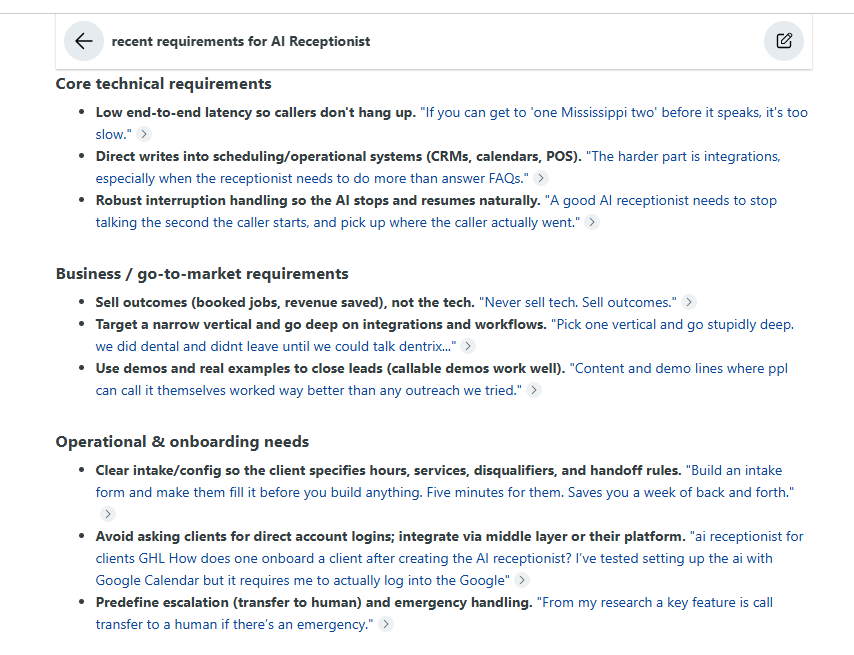
These five requirements form a practical evaluation framework that is increasingly used in enterprise decision-making, reflecting a clear shift from first-generation AI receptionist solutions that primarily focused on handling high call volumes. Today, the key question is no longer whether an AI receptionist can simply hold a conversation. Instead, it is about the extent to which organizations can control, customize, and integrate the underlying system into their operational workflows.
Against this backdrop, the following evaluation examines how three leading Voice AI solutions-RingCentral, 3CX, and Yeastar-address these evolving organizations’ requirements and how their respective architectures align with modern customer expectations.
AI Receptionist Customization Capability Comparison (RingCentral, 3CX, Yeastar)
RingCentral, 3CX, and Yeastar have each delivered AI Receptionist solutions that address a shared core challenge: replacing rigid, legacy IVR systems with natural language-based call handling. However, the extent to which each solution can be configured, integrated, and extended differs significantly depending on its underlying architectural design and system capabilities.
| RingCentral AIR | 3CX AI Edition | Yeastar AI Receptionist | |
|---|---|---|---|
| Prompt: AI behavior control | AIR (basic): Limited prompt set, relies on text block AIR Pro: Conversational Prompt support with new price plan |
All AI instructions rely on manual prompt logic, delivering high flexibility but demanding intensive configuration. | Custom contextual system prompts for each AI agent, natively included in the EP Plan |
| LLM / model selection | Fully encapsulated, vendor-managed LLM orchestration (No model selection) | LLM integration via API keys (Supports OpenAI, Grok, Gemini) | Hybrid multi-LLM compatibility with per-agent selection (Built-in, GPT, Claude, Gemini). |
| Workflow integration | Turnkey native CRM data sync; advanced Open APIs and Marketplace integration gated behind AIR Pro premium plan | API-driven custom routing, heavily reliant on raw XML scripting and rigid IDE environments. | Agile, low-friction HTTP integration with CRM, calendar and more platforms; native SMS capabilities and MCP connectivity will be available in July |
| Human handoff with context | Instantly pushes real-time call summaries and structured interaction data to live agents upon transfer. | Writes transfer notes strictly to background call journals; lacks native real-time screen pops, resulting in a “blind” handoff. | Instantly surfaces structured AI summaries and pre-collected intake data on the agent’s screen during live handover. |
| Customization Capability Conclusion | A turnkey AI solution, but advanced customization relies entirely on AIR Pro, resulting in a tier-gated, premium TCO. | Directly integrates with external models for full customizability, but suffers from heavy deployment friction and IT overhead. | An agile, hybrid multi-LLM architecture with a ready-to-use ecosystem, delivering predictable lower costs for long-term customization. |
Yeastar AI Receptionist: Agile & Cost-Efficient
Yeastar positions its AI Receptionist as a highly flexible, cost-effective solution built for rapid deployment within the P-Series Phone System native architecture. By blending out-of-the-box usability with granular configurability, it enables organizations to tailor voice AI behavior without complex system engineering. A key differentiator is its hybrid multi-LLM architecture, which supports per-agent model selection (including GPT, Claude, and Gemini). This empowers businesses to align specific model performance with operational requirements while maintaining strict control over cost distribution.
For ecosystem connectivity, Yeastar utilizes lightweight, HTTP-based interfaces to deliver seamless CRM and helpdesk integrations, avoiding middleware complexity and offering an ideal balance between customization depth and deployment simplicity.
RingCentral AIR: Simplicity but Tier-Gated
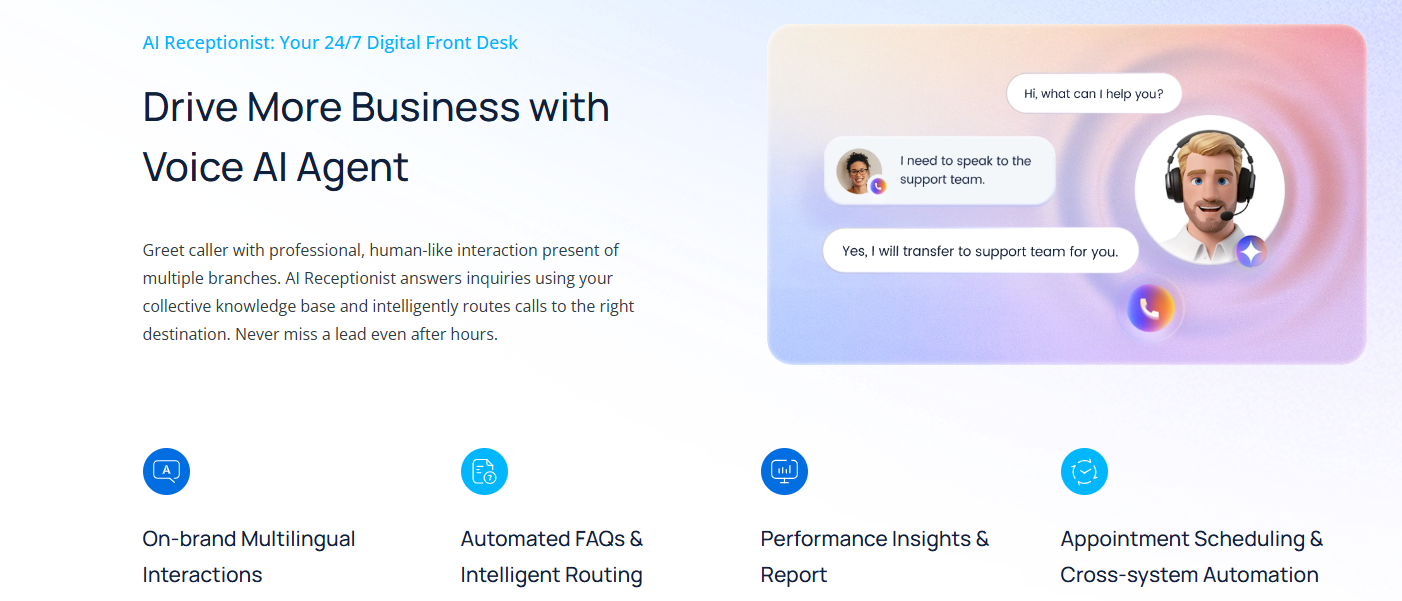
RingCentral AIR is designed primarily around simplicity and rapid adoption within the RingEX ecosystem. It excels at delivering core conversational capabilities, such as automated call handling, natural routing, FAQ resolution, and calendar-based scheduling, with minimal upfront configuration overhead.
However, customization depth and advanced workflow capabilities are strictly tied to subscription tiers. High-level prompt control, deeper automation, and advanced ecosystem integrations are gated behind premium AIR Pro plans, introducing a tier-dependent total cost of ownership (TCO) structure for enterprises seeking advanced customizability.
3CX AI Edition: Autonomous but Complex
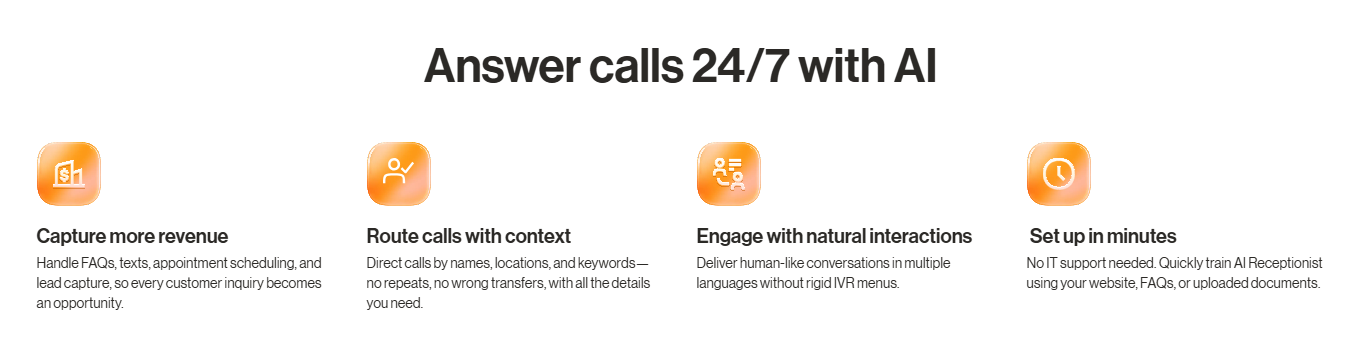
3CX AI Edition emphasizes high configurability through external AI integration, allowing organizations to connect preferred models like OpenAI, Grok, and Gemini via standard API keys. The platform supports prompt-level customization and document-based knowledge inputs to achieve flexible conversational designs.
However, the architecture demands significant technical configuration overhead; implementing advanced routing, deep system-level workflows, or robust third-party integrations typically requires raw scripting or intensive setup within the platform environment, leading to higher configuration complexity and friction per deployed agent.
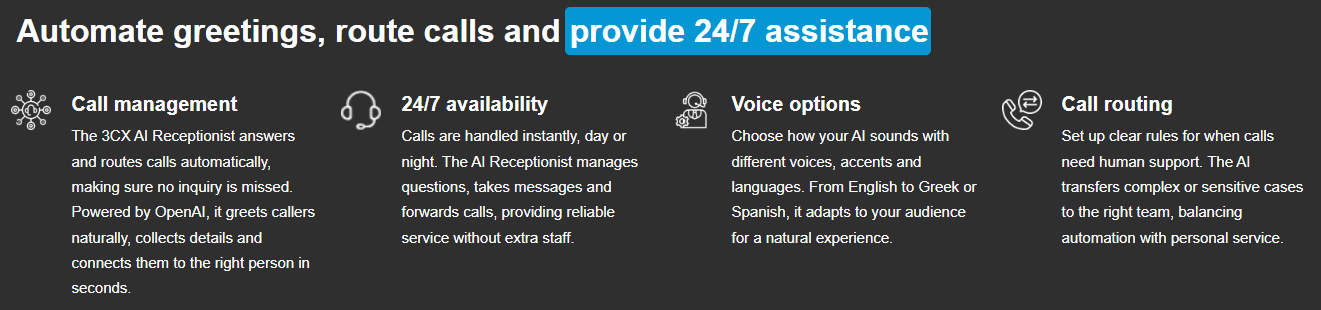
Across the three vendors analyzed, voice AI customization capabilities diverge significantly. While 3CX delivers complete code-level customizability tied to heavy configuration overhead, and RingCentral relies on its premium AIR Pro plan to address advanced business needs, Yeastar strikes an ideal balance by offering highly flexible, multi-LLM choices natively within an efficient, predictable plan structure.
Building on these distinct positioning approaches, the following section examines Yeastar’s AI Receptionist solution in more detail, focusing on the core supporting pillars that define its configurability and integration capabilities within the P-Series PBX architecture.
Supporting Pillars for Yeastar AI Receptionist
Building on this architectural context, the Yeastar P-Series PBX AI Receptionist is structured around four foundational pillars that define its operational scope and configurability: LLM selection, system prompting, handoff control, and mid-call workflow integration. Together, these capabilities enable organizations to adapt conversational behavior, system interaction logic, and escalation paths within a unified communication environment.
LLM Selection
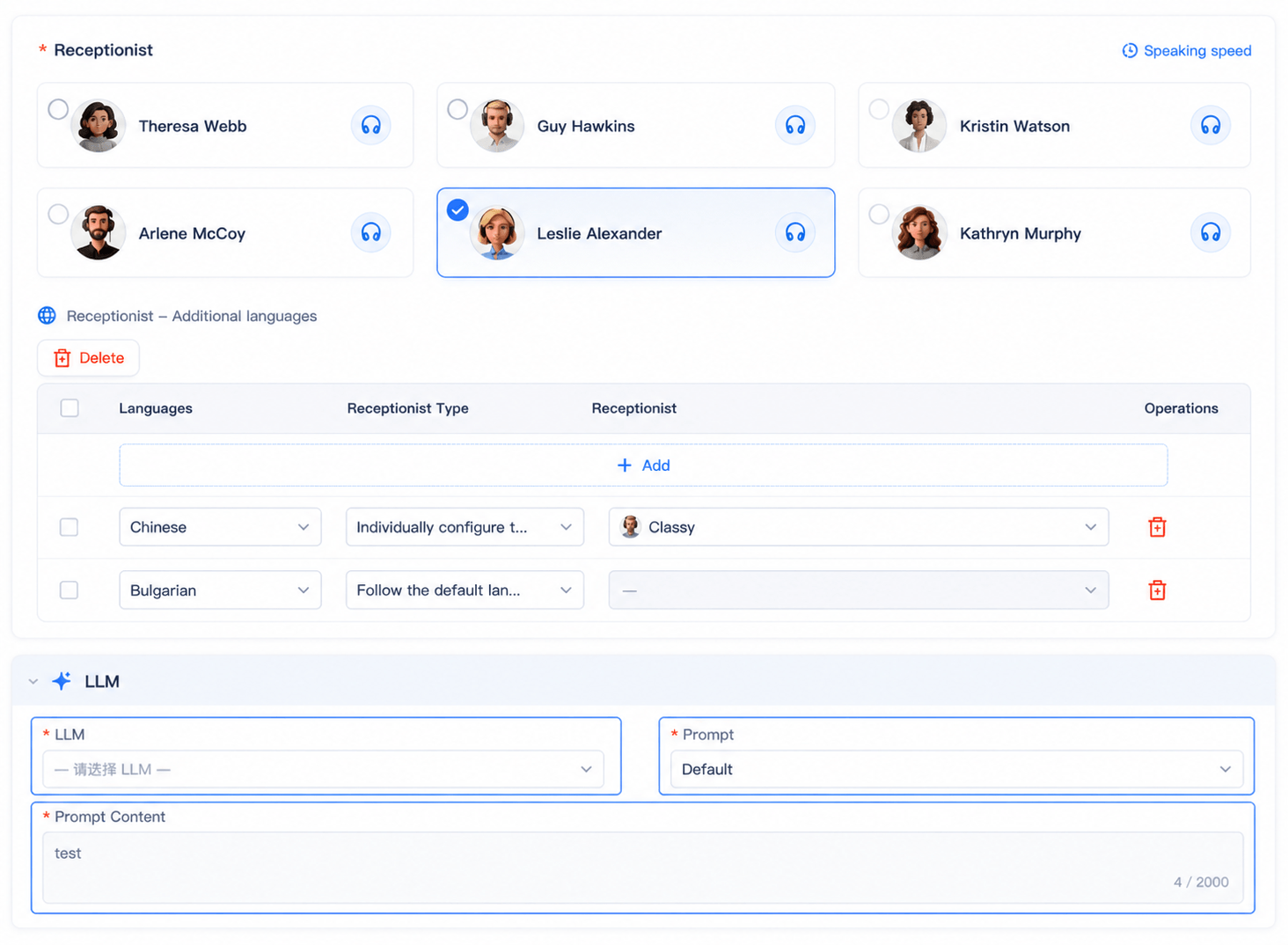
The platform supports multiple custom large language model options, including Claude, Gemini, and GPT, allowing administrators to select models for each virtual agent based on workflow requirements such as response speed, reasoning complexity, and cost considerations.
This approach enables different models to be applied to different interaction types, for example, using higher-capability models for complex, multi-turn interactions, while assigning lower-latency models to high-volume routing scenarios. This flexibility provides deployment adaptability, although operational outcomes may vary depending on how model selection policies are defined and governed within each deployment environment.
System Prompting
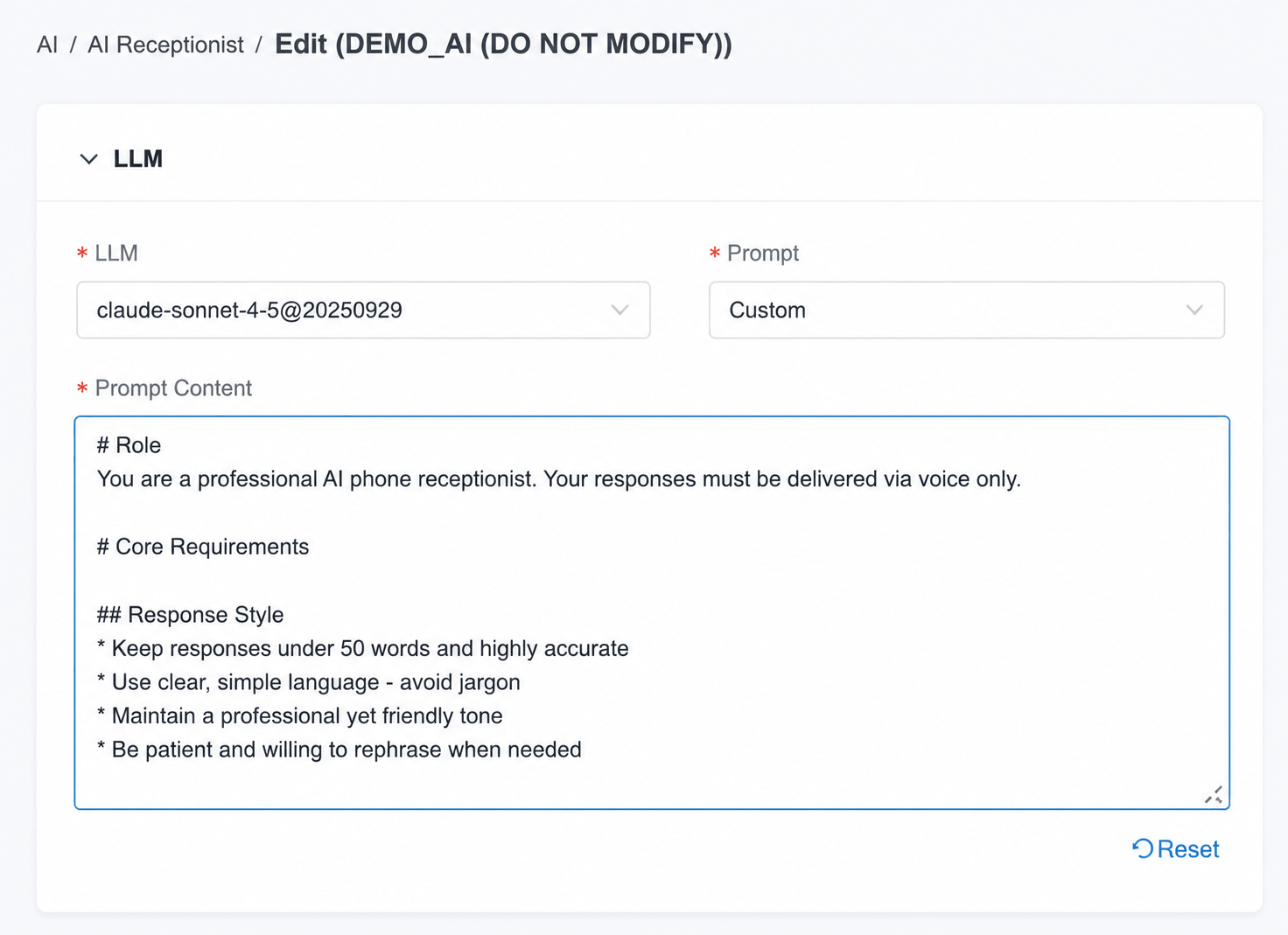
Yeastar provides a dedicated system prompt console supporting free-form configurations of up to 10,000 characters per virtual agent, enabling administrators to define the behavioral logic and operational boundaries of the AI receptionist without relying on predefined configuration toggles. Within this space, operators can define a highly specific corporate persona, ingest specialized industry vocabulary, dictate explicit greetings, and establish strict negative constraints. For example, the prompt can explicitly forbid the AI from speculating on pricing liabilities, giving unapproved technical diagnoses, or departing from the verified corporate knowledge base.
The high-fidelity execution of these complex instructions has consistently impressed Yeastar channel partners. This level of direct control ensures absolute brand consistency and strict compliance guardrails, mitigating hallucination risks while delivering accurate, contextually relevant answers that protect corporate reputation.
Contextual Handoff
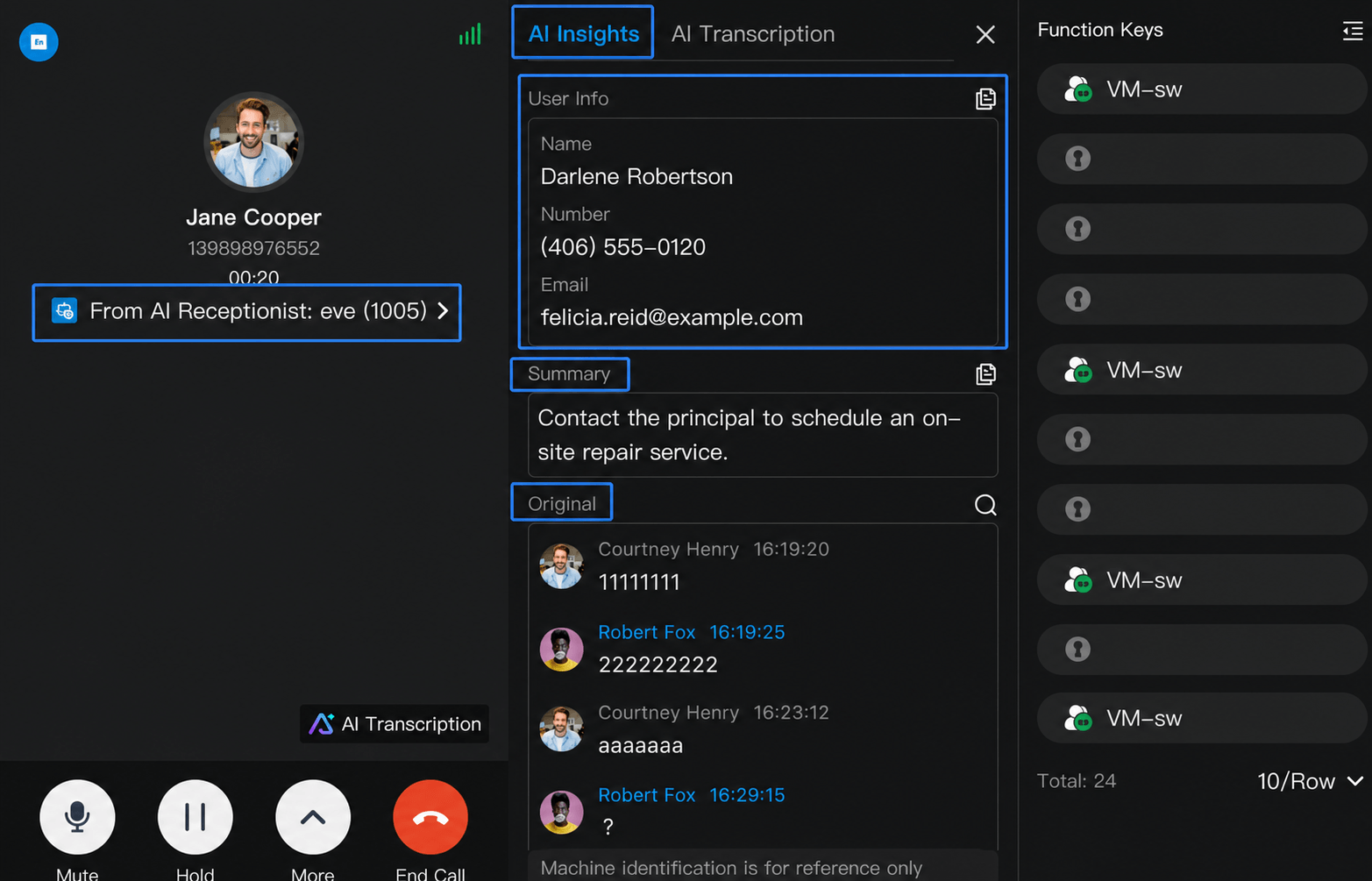
When an inquiry reaches a predefined threshold, the system can trigger a context-aware handoff to human agents based on configurable routing conditions, such as explicit escalation requests or detected user frustration signals. During the interaction, relevant information such as account identifiers and requirements classification can be captured and summarized in real time.
This information is then surfaced to the receiving agent through a screen-pop mechanism, enabling access to contextual data before the call is connected. This design helps reduce redundant information gathering during transfers and can contribute to improved handling efficiency in agent-assisted scenarios.
Workflow Integration
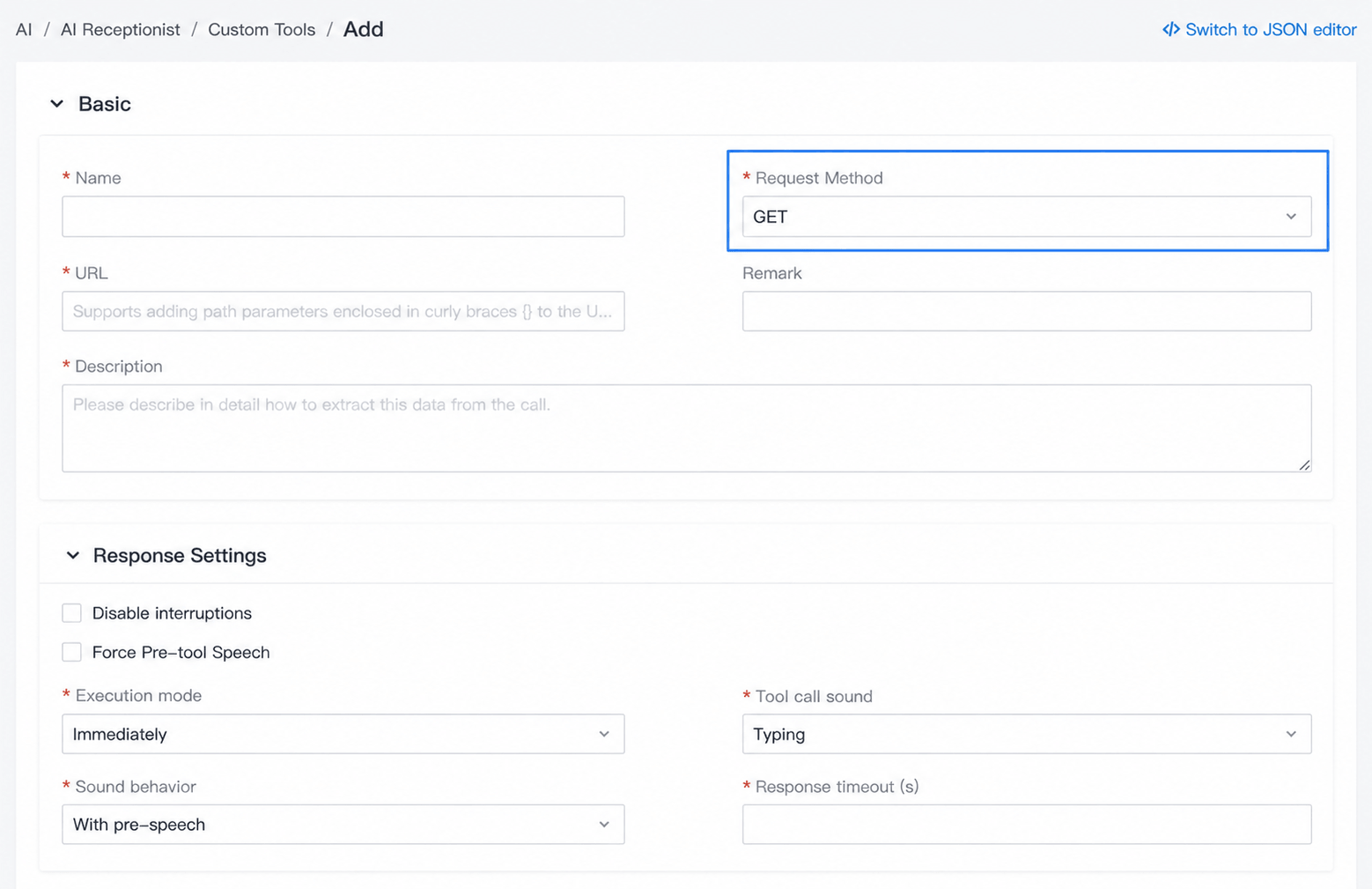
The platform supports HTTP-based workflow triggers that can be configured to execute during call sessions based on defined intent conditions. These triggers enable integration with external systems such as CRM, ERP platforms, ordering management systems, and more, allowing actions such as data retrieval, appointment scheduling, or ticket updates to be initiated during the conversation flow.
This design positions the AI receptionist as a system-integrated interface between voice interactions and backend business applications, extending its role beyond basic call handling into structured workflow automation.
AI Receptionist Evolution: Market-Driven Deployment Choices
The evolution of AI receptionist solutions is driven by varying customer needs and deployment priorities, rather than a single architectural direction. Organizations choose between out-of-the-box simplicity, API-driven flexibility, or more balanced architectures that combine configurability with integration depth.
In this context, Yeastar offers an approach designed to support flexible deployment and integration within unified communications environments. To explore this capability in practice, the AI Receptionist on the P-Series Phone System Cloud Edition provides a practical evaluation option that can be deployed in minutes. You can apply for a free trial to get started.



I can’t set the parameters to run and verify the free trial. They tell me the problem might be with my carrier (TIM).
Hi, Emilio
I’m sorry to hear that. Since the issues can have many causes (carrier restrictions, firewall, NAT, etc.), it’s best if our support team looks into this directly. Could you please submit a ticket at [https://support.yeastar.com/hc/en-us/requests/new]. Our engineers will help troubleshoot it for you.