

 More businesses are questioning whether their traditional phone lines are still doing the job. Legacy PBX systems are expensive to maintain, difficult to scale, and simply were not designed for teams working across offices, homes, and time zones. Hosted VoIP has become the practical answer for many of them. Not because it is a trend, but because it solves real problems: hardware overhead, upgrade costs, and the growing need to support remote and hybrid work without rebuilding communications infrastructure from scratch.
This guide covers everything you need to make an informed decision: what hosted VoIP is, how it works, the key benefits, core features, how to choose the right hosted VoIP system for your business, and more.
Table of Contents
- What is VoIP? →
- What is Hosted VoIP? →
- How Does Hosted VoIP Work? →
- 5 Benefits of Hosted VoIP →
- Hosted VoIP vs. On-Premise VoIP vs. UCaaS →
- Hosted VoIP vs. Cloud VoIP →
- Hosted VoIP vs. Hosted PBX →
- Core Features of a Hosted VoIP Phone System →
- Top Use Cases of Hosted VoIP Solutions →
- Is a Hosted VoIP Phone System Right for My Business? →
What is VoIP?
VoIP (Voice over Internet Protocol) allows voice calls via the Internet instead of traditional phone lines and analog phones. It converts your voice into digital signals, breaks them into data packets, and sends them over the internet. The recipient’s device reassembles these packets into the original voice signal for communication.
Here is a short video to help you understand VoIP in a minute:
What is Hosted VoIP?
Building on the foundation of VoIP, hosted VoIP, also known as Hosted VoIP Phone System or Hosted PBX, takes it a step further by outsourcing management and infrastructure to a service provider.
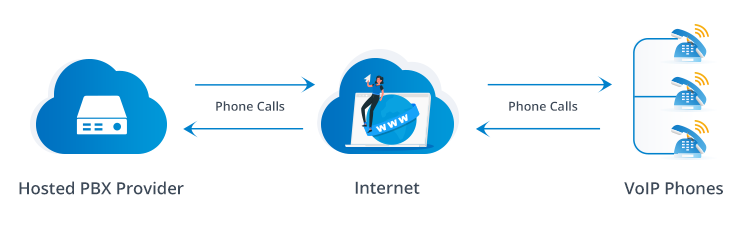
With hosted VoIP, the provider owns and operates all servers, call routing infrastructure, and software at a secure off-site data center. Businesses access a complete phone system over the internet with no on-site PBX hardware to install or manage.
Many hosted VoIP solutions enable communication via softphones, allowing companies without much capital to get their phone systems up and running without having a single IP phone in the office. Therefore, the hosted VoIP phone system is beneficial for small businesses and mid-sized organizations seeking enterprise-grade capabilities without the complexity of managing a private branch exchange system (PBX).
As a cost-effective communication solution, it allows businesses to focus on growth while adapting easily to changing communication needs.

How Does Hosted VoIP Work?
Hosted VoIP operates through a cloud-based infrastructure managed entirely by service providers. Calls can be made and received from anywhere with a stable internet connection, making hosted VoIP systems suitable for remote teams, hybrid offices, and businesses operating across multiple locations.
Here is how a hosted phone system typically handles a call:
Step 1: You Start the Call
An employee places a call using a VoIP phone, softphone, or mobile app. The hosted VoIP system captures the user’s voice and prepares it for transmission over the internet.
Step 2: Your Voice Is Converted into Digital Data
The voice signal is converted into small digital data packets and securely sent through the internet connection. This process happens almost instantly and is invisible to the user.
Step 3: The Provider Processes and Routes the Call
The hosted VoIP provider receives the data and routes the call to the intended recipient. At this stage, advanced hosted VoIP features such as auto attendants, IVR(interactive voice response), and call recording functions can be applied based on predefined business rules.
Step 4: The Call Connects
The digital packets are converted back into audio, allowing both parties to communicate in real time.
This entire process takes place in milliseconds, allowing hosted VoIP systems to deliver a calling experience that feels just as natural as a traditional phone call, whether you’re calling across the office or across the globe.
5 Key Benefits of Hosted VoIP for Businesses
Hosted VoIP delivers more than just phone calls. A modern hosted VoIP service brings together voice, video conferencing, messaging, and call management in a single cloud-based platform that your team can access from any device.
Below are the 5 benefits that make the biggest difference for businesses making the switch.
1. Lower Cost of Ownership
This is the most significant factor. Using a traditional, circuit-based phone system can eat away at your company’s finances on a monthly basis. Many phone companies hike up the prices without warning their customers about it.
Hosted VoIP replaces that uncertainty with a predictable subscription model: no upfront hardware investment, no surprise charges, and no need for a dedicated telephony team to keep things running.
2. An Advanced Feature Set
A traditional PSTN-based phone system covers the basics: calling, answering, and basic call routing. A hosted VoIP phone system includes far more at a comparable (or even lower) cost — AI Features, CRM & Teams Integrations, Contact Center capabilities and more. These features are built into the platform, not bolted on as expensive add-ons.
3. No On-Site Hardware Required
Setting up an on-premise business VoIP system usually comes with having to deal with a whole lot of hardware and cables being brought into the office. The same goes for traditional PBX – if you run a small business with limited office space, every square inch matters.
One of the biggest benefits of a hosted VoIP service is the fact that all that unnecessary clutter is hosted on a data center located off-site, and you just need a stable internet connection to use it. For small businesses and startups where office space and IT bandwidth are limited, this is one of the most immediate practical benefits.
4. Streamlined Office Communications
Hosted VoIP works the same whether your team is at the office, working from home, or across different locations. With a softphone app, employees get full access to every feature from any device. For businesses managing hybrid schedules or distributed teams, this kind of flexibility is not a nice-to-have; it is a requirement.
5. Get Superior Reliability and Security
Reputable hosted VoIP providers help secure business communications through encrypted voice transmission and professionally managed cloud infrastructure. As highlighted by industry best practices from the Cloud Security Alliance (CSA), security, resilience, and continuous monitoring are essential components of modern cloud-based services. Many providers therefore use redundant systems and proactive monitoring to improve service availability, helping businesses maintain reliable communications.
Hosted VoIP vs. On-Premise VoIP vs. UCaaS
There are three main approaches to business communications, and choosing the right one depends on how much infrastructure control you need and what your team actually uses.
On-premise VoIP puts everything on-site. Your organization owns and manages the hardware, which gives you full control but comes with high upfront cost and ongoing IT responsibility.
Hosted VoIP moves that infrastructure to a third-party provider’s data center. You get the same voice capabilities over the internet, without the hardware overhead or IT burden.
UCaaS goes further. It is not just a phone system — it brings voice, video conferencing, messaging, and collaboration tools into a single cloud-based platform, built for the way modern teams actually work.
Here is how the three options compare across the dimensions.
| On-Premise VoIP | Hosted VoIP | UCaaS | |
|---|---|---|---|
| Deployment | On-site PBX server | Provider-hosted PBX | Fully cloud-based service |
| Upfront Investment | High | Low | Minimal |
| Monthly Cost | Low ongoing cost | Moderate | Subscription-based |
| IT Maintenance | Customer-managed | Provider-managed | Fully provider-managed |
| Scalability | Hardware-dependent | Moderate | Highly scalable |
| Remote Work Support | Requires VPN or additional setup | Built-in | Built-in |
| Reliability | Customer infrastructure dependent | Provider dependent | Enterprise-grade cloud redundancy |
| Best For | Organizations requiring full control | SMBs seeking simple cloud telephony | Businesses seeking an all-in-one communications platform |
Hosted VoIP vs. Cloud VoIP
Hosted VoIP and Cloud VoIP are often used interchangeably, but they are not identical. Cloud VoIP is a broad category of internet-based communication systems, while Hosted VoIP refers to a provider-managed VoIP phone system that delivers full business communication functionality.
In other words, all Hosted VoIP solutions are Cloud VoIP systems, but not all Cloud VoIP systems are fully managed Hosted VoIP solutions.
| Hosted VoIP | Cloud VoIP | |
|---|---|---|
| Definition | Managed business phone system | Broad internet-based VoIP category |
| Infrastructure | Provider-managed cloud system | Varies by provider |
| Features | Fully VoIP phone system(call routing, auto attendants, etc.) | Basic to advanced, depending on the solution |
| Business readiness | Enterprise-ready | Depend on the configuration |
| Support | Full provider support | Varies |
Hosted VoIP vs. Hosted PBX
Hosted VoIP and Hosted PBX are closely related but differ in feature depth. Hosted VoIP focuses on delivering voice communication over the internet, while Hosted PBX is a more advanced business phone system that includes additional call management and enterprise communication features.
Hosted PBX is essentially an expanded hosted VoIP system with advanced PBX functionalities.
| Hosted VoIP | Hosted PBX | |
|---|---|---|
| Core Function | Cloud-delivered voice communications | Cloud-delivered business phone system with PBX functionality |
| Service Scope | Calling-focused communication service | Complete PBX platform managed by a service provider |
| Features | Essential calling and collaboration features | Advanced IVR, queues, and PBX administration |
Core Features and Capabilities of a Hosted VoIP Phone System
Hosted VoIP extends beyond basic calling by providing a cloud-based business communication system that integrates multiple tools into a single platform. Below is an overview of the key features you should consider based on your company’s needs:
-
Call queues/call routing: Ensure incoming calls are distributed to the right agent or department efficiently, improving response times and customer experience.
-
Call forwarding: Effortlessly redirect incoming phone calls to a mobile or alternate telephone number when you are unavailable.
-
Built-in call analytics: Features like call reports provide real-time and historical insights into call performance, helping businesses monitor activity and optimize communication efficiency.
-
Video conferencing: Enable face-to-face communication through a unified communication platform without requiring separate tools.
-
Native Softphone app: Enables users to make and receive business calls from desktop and mobile devices over an internet connection, eliminating the need for traditional desk phones.
-
Advanced AI Features: Advanced AI features like AI Receptionist, AI Transcriptions, and Summaries can help improve productivity through smoother call handling.

Top Use Cases of Hosted VoIP Solutions
1. Small and Medium-Sized Businesses (SMBs)
SMBs commonly adopt hosted VoIP to replace traditional phone lines and reduce communication costs while gaining access to a modern, scalable business phone system. With a hosted VoIP phone system, small businesses can access enterprise-level features such as auto attendants, voicemail-to-email, and Microsoft Teams integrations without investing in complex on-premise PBX infrastructure.
2. Remote and Hybrid Work Teams
Unlike legacy phone systems that charge high international calling rates, hosted voice solutions allow businesses to make cross-border calls at little or no additional cost beyond standard usage. In many cases, internal calls within the same VoIP phone system are treated as local calls, even when employees are located in different countries. This makes hosted VoIP a cost-effective communication solution for distributed teams, supporting modern remote work and global business communications.
3. Customer Support & Contact Centers
Hosted VoIP is a strong fit for customer support teams and contact centers that need to handle high volumes of inbound and outbound calls efficiently.
By using a managed VoIP system, businesses can enable a better customer experience across distributed support teams. Therefore, response times and customer satisfaction can be drastically improved.
Is a Hosted VoIP System Right for My Business?
Determining if Hosted VoIP is right for your business depends on your communication needs, budget, and infrastructure requirements.
When Hosted VoIP is a good fit
- When your business is in a growth phase and needs to frequently add or remove users without investing in additional phone lines or PBX hardware.
- When your team is distributed or remote and requires communication through an internet connection.
- When your business wants to avoid managing on-premise phone systems and prefers a cloud-based hosted VoIP system managed by a provider.
Key considerations
While hosted VoIP offers flexibility and cost savings, businesses should consider the following:
- A stable, high-speed internet connection is required for consistent call quality.
- Security and compliance requirements should be evaluated when selecting a provider.
Final decision
In summary, hosted VoIP service is best suited for small and medium-sized businesses, remote and hybrid teams, and organizations that need a scalable phone system for modern business communications.
Why Choose Yeastar Hosted VoIP Service
Trusted by over 650,000 organizations worldwide and backed by 20 years of industry experience, Yeastar P-Series Cloud Edition (PCE) delivers a secure and reliable VoIP solution designed to support modern business communications at scale.
It unifies voice, video, messaging, and customer experience, suitable for organizations of all sizes. With monthly updates, training, and ongoing support, Yeastar ensures a smooth user experience and continuous system improvement.
Yeastar offers a 30-day free trial with no credit card required. Experience the efficiency and scalability of Yeastar’s communication system firsthand!

Frequently Asked Questions (FAQs)
1. Can I host my own VoIP?
While it is possible to host your own VoIP system, it is typically a complex and resource-intensive process that requires technical expertise, dedicated infrastructure, and ongoing maintenance. For most businesses, a hosted VoIP system is a more practical option, offering a simpler setup, lower operational burden, and more predictable costs.
2. Will my existing desk phones work with hosted VoIP?
In many cases, existing desk phones can work with a hosted VoIP system if they are SIP-compatible or can be configured for VoIP use. However, older analog devices may require an adapter or replacement to ensure full compatibility with modern business phone systems.
3. What are some drawbacks of VoIP?
While VoIP offers many benefits, it also has some potential limitations to consider. Since VoIP relies on an internet connection, call quality can be affected by unstable networks, latency, or bandwidth issues, which may result in jitter.


I have sold several devices of the call center and installed and set them up. They have very good facilities and reasonable prices in Iran. I am satisfied. If the trainings can be present, it will be very good. Thank you.Yeastar very good