

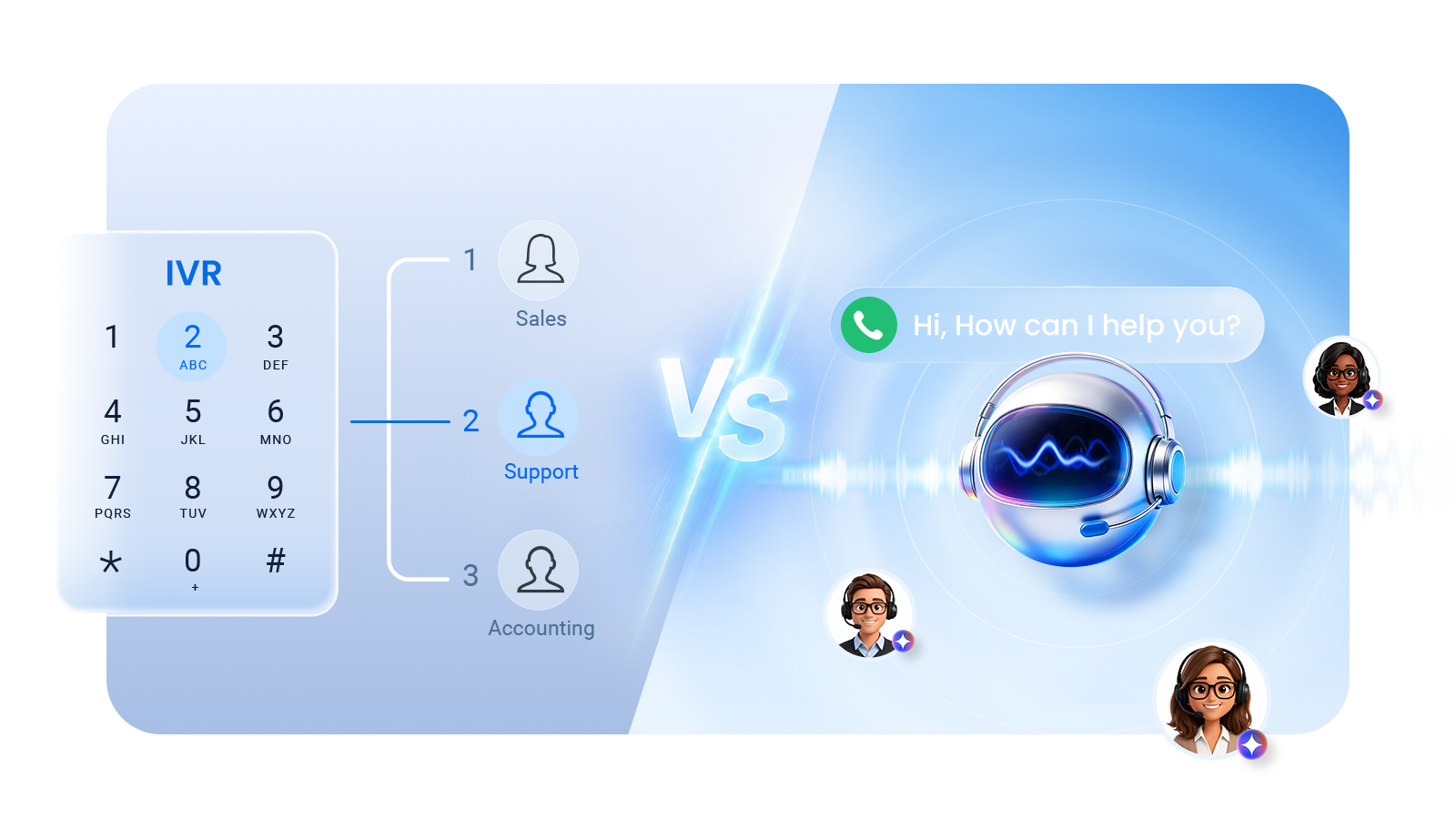
Automated call handling has evolved from IVR systems to AI voice agents. Many providers frame the newer technology as a replacement for the older one. But in our own deployments, and in the feedback from users already using both, the consistent conclusion is different: a good technology earns its place by fitting the scenarios that need it, not by saying no to what came before. In certain scenarios, an IVR system remains the safer choice today. This article compares the IVR vs. AI voice agent technologies, lays out their respective strengths, and explains how to choose the right option based on calling scenarios.
IVR and AI Voice Agents: Definition
IVR (Interactive Voice Response) is an automated call-handling feature built into a business phone system. It plays recorded or synthesized prompts and collects caller input via keypad tones (DTMF) or constrained speech recognition, then routes calls to the corresponding extension, department, or queue. Every path is preconfigured, so behavior is identical on every call and fully predictable.
A Voice AI Agent is an autonomous, conversational agent for business communications built on speech recognition (ASR), large language model (LLM) reasoning, and neural text-to-speech (TTS). It understands free-form speech, holds multi-turn dialogue, executes tasks across integrated systems via function calling, and escalates with context when a human is needed.
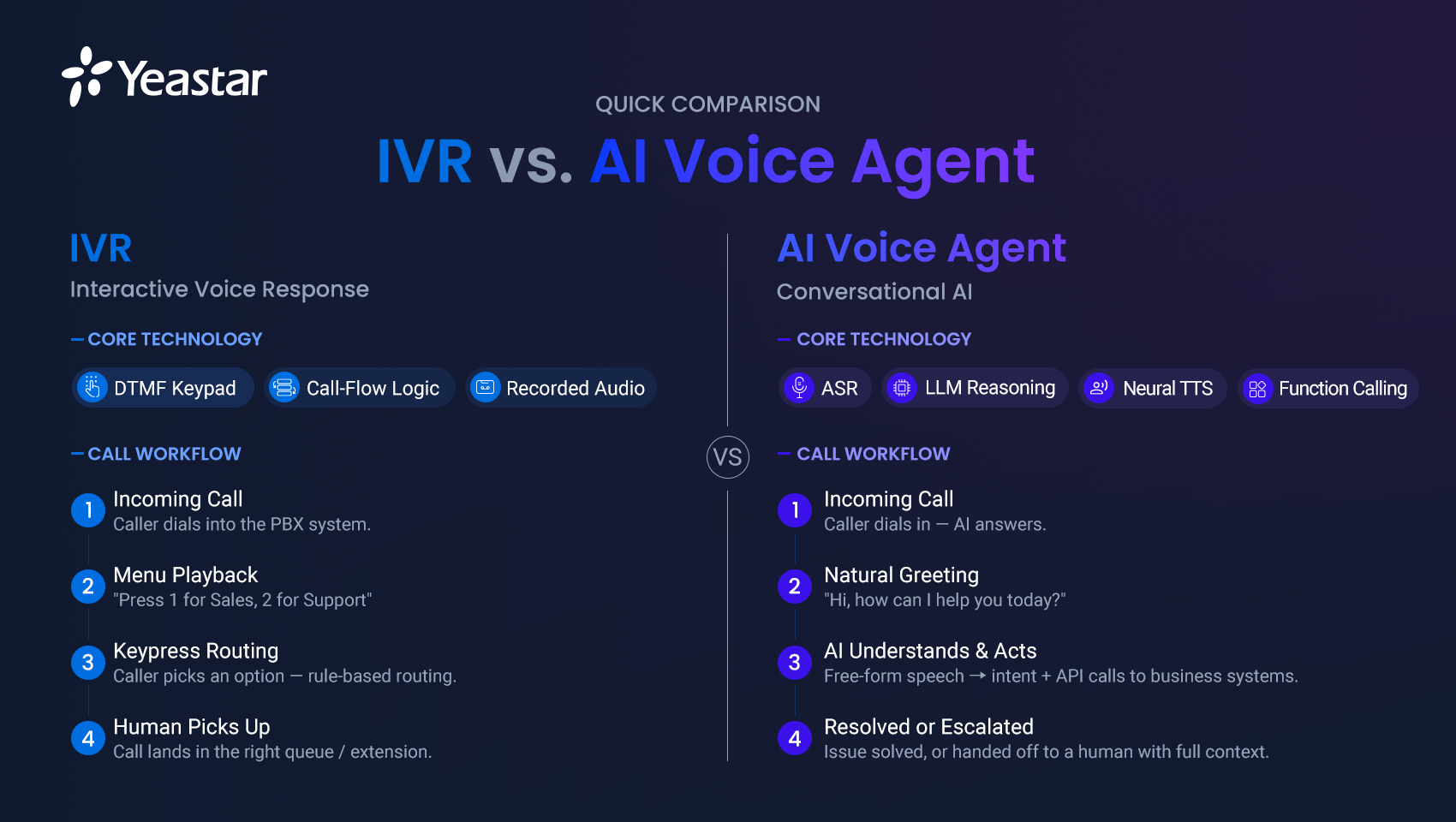
AI voice agent vs IVR, side-by-side comparison
The main difference between these two technologies is that IVR routes calls based on preset rules, whereas AI voice agents interact based on context.
| Dimension | IVR | Voice AI Agent |
|---|---|---|
| Interaction | Keypress / limited voice recognition | Natural language conversation |
| Context memory | None or minimal | Maintained across turns |
| Language support | Single-language menus | Multilingual |
| System integration | Routes to extensions / queues / departments | Reads and writes business systems via HTTP/API |
| Cost at scale | Near-zero marginal cost | Constrained by LLM inference costs |
| Predictability | Same path every time; auditable | Flexible, with output uncertainty |
| Deployment barrier | Built into most PBXs | Requires model and system integration |
These differences are not flaws, they are different design choices. IVR optimizes for deterministic routing at minimal cost. A Voice AI Agent optimizes for understanding and resolving within the conversation. Each design serves a different need, which means each has scenarios where it is the better answer. The next two sections identify the specific properties that define those scenarios.
Where IVR Still Fits
An IVR system’s value comes from three properties that are direct consequences of its rule-based design.
- Precision. Because every path is preconfigured, the routing outcome is 100% predictable. The caller always reaches the exact, predetermined destination with no interpretation or guesswork. This determinism is valuable in any operation where consistency at volume matters.
- Bounded scope. IVR does exactly what it is configured to do and nothing more. It will not interpret a caller’s intent, offer unsolicited help, or deviate from the script. In environments where any deviation from the defined process is a risk, this is exactly the safety property you need.
- Cost. IVR runs on standard telephony infrastructure with near-zero marginal cost per call. No AI inference, no model latency, no per-minute API charges. At high volume, this cost structure is unmatched.
These properties map directly to three typical scenarios:
- High-volume precise department routing. Telecom operators and large banks handle tens of thousands of calls daily, and most callers know exactly which department they need. A keypress IVR menu completes routing in seconds at near-zero cost, where IVR’s economy and precision deliver value together.
- Compliance-driven fixed paths. Regulated scenarios such as financial identity verification or medical triage require every call to follow an identical, auditable flow. Bounded scope ensures the system cannot deviate: the same steps run every time, and the full call path can be replayed for audit.
- Simple needs, limited budget. For SMBs whose call flows have only three or four branches, a standard IVR menu is sufficient. Low cost and simplicity make it the practical choice.
Where AI Voice Agent Excels
A Voice AI Agent’s value comes from four capabilities that are direct consequences of its LLM-based design.
- Natural-language understanding. Callers don’t need to know which department owns their problem. They describe it in their own words: “My order should have arrived last week, and nobody answered my email either.” IVR handles routing through menu selection; an AI voice agent parses the intent directly and acts on it.
- Context memory. IVR processes each menu selection independently. Voice AI Agents maintain context across turns, so if a caller adds “actually, I also need to change the delivery address” mid-conversation, the agent continues without requiring the caller to start over.
- Flexible system integration. Through function calling, a Voice AI Agent connects to CRM, ERP, booking, and ticketing systems and reads or writes data during the call. Where IVR routes to a destination, an AI voice agent can also complete the action itself.
- Multilingual handling. A Voice AI Agent, built on multilingual models, switches languages mid-call without any per-language configuration.
These capabilities enable AI Voice Agent to handle scenarios that go beyond routing:
- Complex, multi-intent conversations. Real callers bundle requests: “I’d like to move my Tuesday appointment, and can you also explain your refund policy?” Natural-language understanding and context memory let an AI voice agent parse multiple intents in one call, maintain context as the conversation shifts between topics, and resolve each request without transferring the caller between departments.
- Autonomous resolution through system integration. When a caller’s request requires action, not just routing, an AI voice agent can complete it within the call. It checks order status in the CRM, reschedules appointments in the booking system, creates tickets, and processes inquiries directly through connected backends. This is particularly valuable outside business hours or during peak congestion, when no human agent is available. The AI doesn’t just answer the call; it resolves the caller’s need end-to-end, turning potential missed opportunities into handled requests.
- Multilingual service. Healthcare providers, legal services, and businesses serving multilingual communities often receive calls in multiple languages within the same day. AI voice agents switch languages mid-call within a single conversation flow.
In Practice: Combining IVR and Voice AI Agent
IVR delivers precise, deterministic routing at near-zero cost. An AI voice agent delivers conversational understanding, system integration, and multilingual resolution. IVR and AI voice agents address different stages of a caller’s journey, and most businesses need both.
A clinic needs IVR triage routing during business hours, when staff is available, and callers expect structured options, and conversational AI after hours, when no one is in the office, and callers need to book or reschedule without waiting. A bank needs auditable IVR verification paths for identity checks, and AI-powered natural-language support for complex account inquiries that don’t fit a menu. A small business needs a simple three-branch IVR menu for the daytime, and a 24/7 AI voice receptionist for missed calls that would otherwise go to voicemail and never get a callback.
In each case, the call flow requires both precision routing and conversational resolution, not because one technology compensates for the other’s weakness, but because the business serves different types of callers at different times. An integrated phone system with IVR and AI voice agent supports both, without forcing a choice, is what makes this practical.
The Yeastar P-Series Phone System offers both IVR and AI voice receptionist (AI Receptionist) as native features of the same platform. IVR comes built-in with multi-level menus, time-based routing, and multi-language options. AI Receptionist is a natively integrated voice AI agent with no third-party integration required, offering 24/7 answering, multilingual conversations in 34 languages, knowledge-base Q&A, intent-based routing, and in-call actions through custom tools or MCP Server.
Using IVR and AI voice receptionist in P-Series PBX requires no code. In the admin portal, you can configure a standardized IVR path, a flexible AI Receptionist, or combine both in a single call flow — assigning them as destinations of the same inbound route, or setting an IVR keypress destination directly to an AI voice agent. The entire caller journey, from first greeting to resolution or human handoff, runs within one system, with no number changes and no external dependencies.

How to Decide: Match the Technology to the Call
Whether you are selecting an automated call-handling system or configuring scenario-based routing for your business, three questions help you choose between IVR and AI voice agent, and a few practical tips help you put the configuration to work.
- What does the caller know when they dial in? If they know exactly which department they need, IVR routes them there in seconds at near-zero cost. If they need to describe a problem in their own words, a Voice AI Agent understands and resolves it directly.
- What are your call volume and call types? Tens of thousands of daily calls, mostly routing: IVR precision and cost structure win. Moderate volume with complex, varied requests: a Voice AI Agent’s understanding and integration capabilities deliver higher per-call value.
- Do your calls span both types? Most growing businesses have calls that need deterministic routing and calls that need conversational resolution, sometimes within the same call flow. When the answer is yes, an integrated IVR and AI voice agent architecture that supports both is the practical choice.
Three configuration tips once you have your answers:
- Start with one scenario. Pick a single, well-defined use case (such as after-hours answering) as your pilot, rather than redesigning the whole call flow at once.
- Route by context, not by habit. Use time-based routing to send business-hours calls to IVR and after-hours calls to AI, or set an IVR keypress destination directly to an AI agent, so each call type meets the technology built for it.
- Let data decide expansion. Run the pilot for two weeks, compare missed-call rates and resolution rates before and after, and expand only where the numbers justify it.
See the Difference Yourself
The clearest way to understand how IVR routing and conversational AI differ is to experience both. With the P-Series PBX 30-day free trial, you can configure a standard IVR path and an AI voice agents side by side, route real calls through each, and design the call flow that fits your business.