


Switching a PBX or unified communications platform is rarely just a technical decision.
For IT service providers, MSPs, and resellers, it affects deployment models, operational efficiency, security posture, and long-term customer ownership.When a current PBX system no longer aligns with business goals, whether due to licensing limitations, deployment complexity, or partnership structure, providers begin exploring alternatives.
Before migrating to a new platform, here are the key questions experienced IT providers ask to ensure the transition is strategic rather than reactive.
Jump to ↓
- What are the key operational advantages of choosing Yeastar as a PBX platform?
- How secure is Yeastar’s Remote Access Service and communication infrastructure?
- How flexible is Yeastar in supporting businesses with multiple departments, brands, or time zones?
- How strong are Yeastar’s integration capabilities?
- Does Yeastar support white-labeling and reseller branding?
- What deployment options does Yeastar offer?
- What licensing options does Yeastar offer?
- How does Yeastar compare to other brands in terms of pricing and partner support?
- How does Yeastar support migration from other PBX systems?
1. What are the key operational advantages of choosing Yeastar as a PBX platform?
Choosing a PBX platform is rarely just about features. For service providers, it’s about operational control, commercial flexibility, and long-term scalability.
Yeastar P-Series phone system delivers improvements in both business model and platform capabilities:
- Flexible & Partner-Centric Commercial Model:
No direct sales competition, no forced updates, optional white-label branding, and flexible Simultaneous Call (SC) or Per-Extension licensing to fit different customer sizes. - Centralized Management:
Manage multiple PBX instances from a single platform (both self-hosted and Yeastar-hosted) with tools for bulk upgrades, backups, restores, and proactive system monitoring. - Granular Feature & Permission Control:
Advanced capabilities such as role-based permissions, selectable outbound caller IDs, disaster recovery, and customizable call handling options. - Extensive Device & Trunk Compatibility:
Supports 500+ IP phone models for auto-provisioning and integrates with 210+ SIP trunk providers worldwide through a dedicated ITSP program. - Modern Softphone Experience (Linkus UC Client):
Desktop, Web, and mobile clients with intuitive UI, drag-and-drop operator panel controls, and better call quality. - Security by Design:
Layered built-in security features, encrypted communication architecture, and proactive safeguards such as outbound call frequency restrictions.

2. How secure is Yeastar’s Remote Access Service and communication infrastructure?
As remote work, hybrid offices, and distributed SIP endpoints become the norm, secure remote connectivity is no longer optional — it’s essential.
Yeastar addresses this need through its Remote Access Service (RAS), a private tunneling solution designed to simplify and secure remote SIP phone registration and softphone connectivity.
RAS includes an inbuilt Cloud SBC that encrypts signaling and media streams (such as SIP and RTP). All data transmitted through RAS is end-to-end encrypted using a unique encryption key for each PBX, protecting communications from eavesdropping and unauthorized access.
Importantly, RAS does not store transmitted data. It functions purely as a secure conduit between endpoints and the PBX, maintaining privacy and compliance.
In addition, administrators can define IP-based and account-level restriction rules to control traffic sources — allowing or blocking access by specific IP addresses, extensions, or groups.
Yeastar currently supports secure remote SIP connectivity through:
- RAS with inbuilt Cloud SBC
- On-site Proxy (released in March) for localized deployment scenarios
- Encrypted signaling and media transmission
- Granular IP and account-based access control
→ Explore Yeastar security features and architecture

3. How flexible is Yeastar in supporting businesses with multiple departments, brands, or time zones?
Very flexible — and this is where Yeastar stands out. Many organizations operate across multiple brands, regional offices, or business units. Rather than requiring separate PBX systems, Yeastar enables granular configuration within a single instance. For example:
Music on Hold & Call Prompts:
Assign different MOH, welcome prompts, or ringback tones to specific extensions, queues, or ring groups — instead of relying on a global setting.
Multi-Time Zone Configuration:
Configure up to 24 independent time zones in one PBX, each with its own business hours and holiday rules. These can be applied across extensions, queues, and routing components.
→ Learn more about Multi-Time Zone settings
Selectable Outbound Caller IDs (DOD):
Create groups of outbound caller IDs and allow users to choose which number appears when making calls via the Linkus app.
Multi-Language Voicemail Support:
Let each extension define the system language for voicemail prompts, improving caller experience across regions.Beyond feature-level customization, Yeastar also provides granular user permission control by role and extension group — allowing administrators to define not only access rights, but even feature visibility within UC clients.
This flexibility enables service providers to support complex, multi-entity customers under a single PBX deployment — reducing infrastructure overhead while maintaining operational clarity.
4. How strong are Yeastar’s integration capabilities?
Yeastar supports integrations across multiple layers of modern business communications, from business applications to collaboration tools and customer engagement channels. For example:
CRM & Helpdesk Integrations
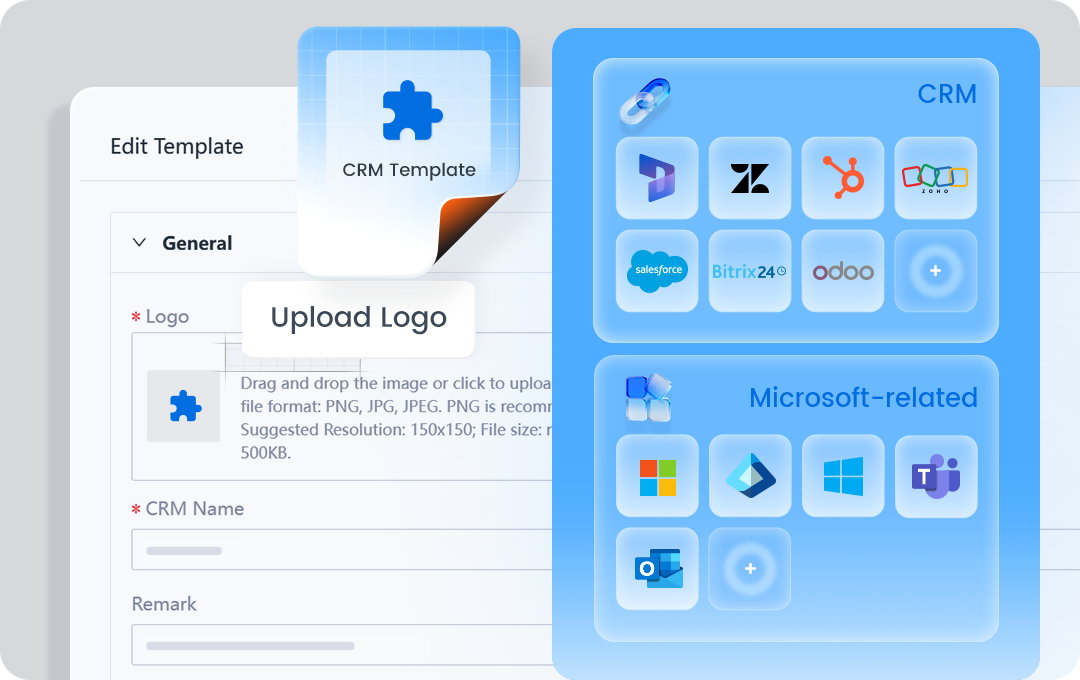
Yeastar P-Series PBX includes an inbuilt CRM integration template, making it easy to connect with any CRM that supports REST APIs. It also offers pre-built integrations with platforms such as Salesforce, Zoho, HubSpot, Zendesk, Bitrix24, Odoo, and Microsoft Dynamics 365. → Find more CRM integration here.
Microsoft Teams Compatibility
Yeastar can integrate calling with Microsoft Teams environments, supporting organizations that standardize on Teams for collaboration.
Omnichannel Messaging Integration
Yeastar enables unified customer conversations across WhatsApp, Facebook Messenger, SMS, and Live Chat, bringing messaging into a single workflow.
Industry-Specific Integrations (e.g., Hospitality)
For vertical scenarios, Yeastar supports a built-in hotel module as well as integration with hotel PMS systems to streamline front-desk and guest communication workflows.
Overall, this mix of flexible app integrations and channel connectivity helps service providers deliver solutions that fit real customer ecosystems. → Check Yeastar App Marketplace
5. Does Yeastar support white-labeling and reseller branding?
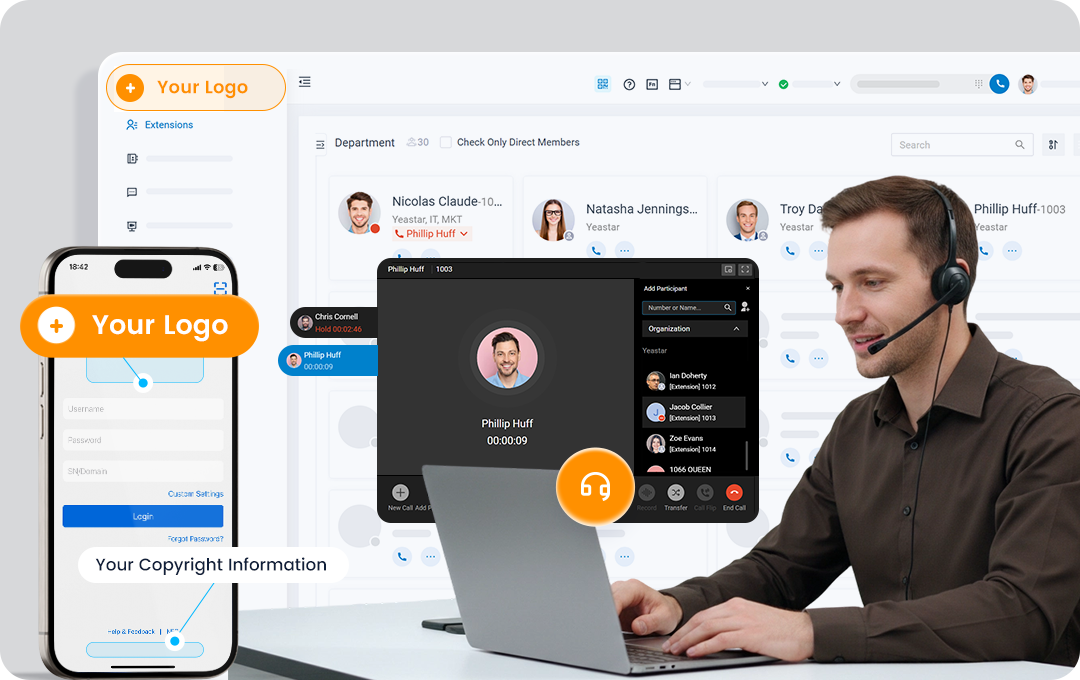
Yes, and it goes beyond surface-level branding. Yeastar offers a full white-label suite, covering the PBX platform, softphone applications, and the centralized management platform (YCM). Partners can fully align the solution with their own brand identity across customer-facing touchpoints.
Customization includes:
- Logo integration and custom PBX domain
- Branded login pages and UI styling
- Brand color schemes and interface themes
This enables service providers to deliver a truly private-labeled UCaaS experience, strengthening brand ownership, controlling margins, and eliminating vendor visibility. For partners building long-term recurring revenue models, white-labeling is not just a feature — it’s a strategic advantage.
6. What deployment options does Yeastar offer? Can it be deployed on private infrastructure or third-party cloud platforms?
Yes. Yeastar supports both self-hosted and Yeastar-hosted deployment models.
Self-Hosted Deployment
For service providers who prefer full infrastructure control, Yeastar PBX can be deployed:
- On-premises servers
- Third-party public cloud platforms such as AWS, Microsoft Azure, Google Cloud, DigitalOcean, OVHcloud, and others
- Virtualization platforms including VMware, Hyper-V, KVM, and Proxmox
This model allows partners to meet specific compliance, data residency, or infrastructure requirements. For server requirements and deployment details, please refer to the installation guide.
Yeastar-Hosted Deployment
For partners seeking a fully managed option, Yeastar offers cloud-hosted PBX instances with selectable regional data centers.
The turnkey solution removes infrastructure complexity — no server maintenance, patching, or system upkeep required — while delivering reliable, scalable cloud performance.
7. What licensing options does Yeastar offer?
Yeastar supports both SC (Simultaneous Call) and Ext. (Per Extension) licensing model. Yeastar does not publish any price online, so partners set their own pricing plans and packages. All licenses can be activated instantly through the Yeastar Partner Portal.
Worth noting that the supported licensing models vary by region. It’s recommended to contact Yeastar or their local distributor directly for a full pricing quote.
8. How does Yeastar compare to other brands in terms of pricing and partner support?

Yeastar operates as a channel-only, partner-first vendor, designed to protect partner margins and customer ownership. Partners benefit from stable, flexible licensing and competitive pricing, often delivering more advanced functionality at comparable cost levels.
Support is structured around fast response and direct partner access. More importantly, product development is driven by feedback — in 2025 alone, Yeastar delivered 10 updates and 90+ product improvements based on partner and customer inputs.
Rather than treating partners as resellers, Yeastar positions them as long-term collaborators.
9. How does Yeastar support migration from other PBX systems?
Migration can be one of the biggest barriers when switching platforms.
For most PBX environments, Yeastar simplifies the transition through its Centralized Management platform, enabling batch configuration, bulk provisioning, and streamlined deployment workflows. This significantly reduces migration time and minimizes manual setup across multiple instances.
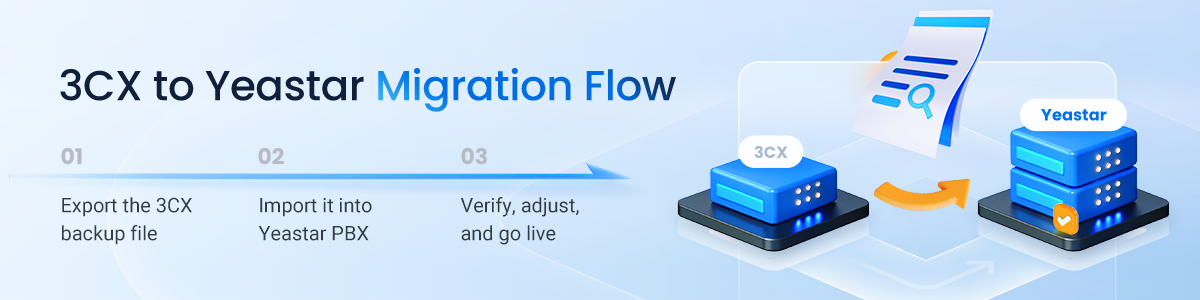
For 3CX users specifically, Yeastar provides a dedicated migration tool that allows direct import of 3CX backup files. Key elements such as extensions, routing rules, IVR prompts, voicemail audio, and device associations can be automatically mapped and restored, accelerating the transition process.
Closing Thought
Selecting a PBX platform is not simply a feature comparison exercise. It is a strategic decision affecting deployment efficiency, operational scalability, security posture, and partner profitability.
Yeastar’s approach focuses on flexibility, secure architecture, granular customization, and strong partner alignment, making it a platform built not only for end users, but also for the service providers who support them.