
Inside NovoOne: How the Architecture Drives Down OpEx and Guarantees High Availability
7.6 min read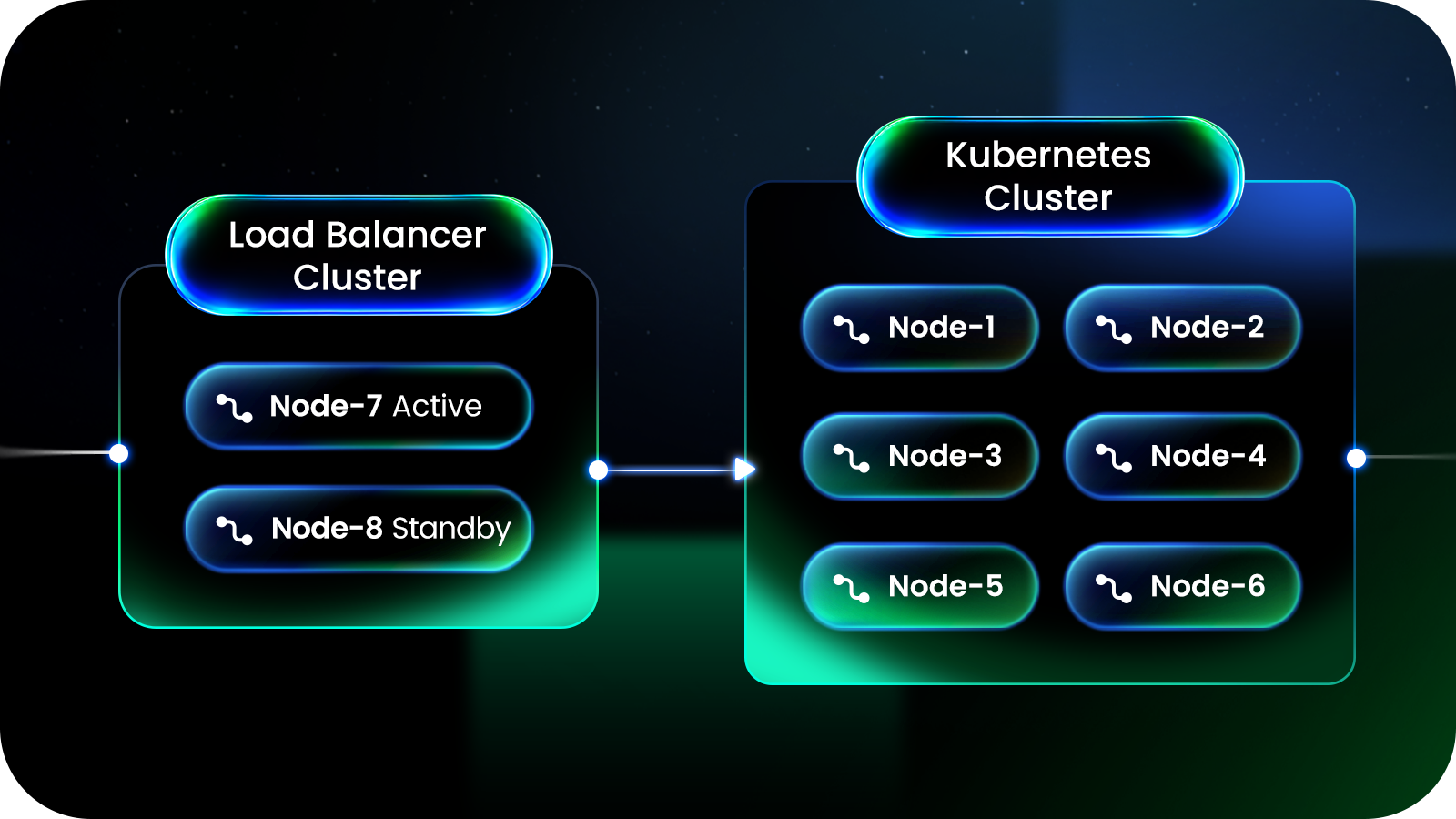
For service providers managing thousands of tenants, every technical weakness is amplified by scale. Service impact comes first: when the platform degrades or goes down, it affects not one customer, but your entire tenant base at once. Resource utilization comes second: idle or over-provisioned capacity isn’t an isolated line item, but a compounding cost multiplied across thousands of tenants, month after month. And operations come third: every upgrade and maintenance window carries real labor and downtime cost, repeated across the entire platform.
At multi-tenant scale, legacy monolithic PBX architectures start to fall short. Signaling and media share one process, so a registration storm degrades live calls. Upgrades mean late-night maintenance windows and planned downtime, and scaling means purchasing entire servers. Failure detection, meanwhile, too often relies on customers calling to complain. The industry math is brutal: in ITIC’s 2024 survey of over 1,000 enterprises, 91% of mid-size and large organizations put a single hour of downtime above $300,000, and for a platform hosting thousands of tenants, every minute of outage multiplies across your entire client base.
NovoOne Communications Platform was built to break this cycle. By combining Kubernetes with SIP Stack, it pairs a carrier-proven media engine trusted across the telecom industry with the orchestration platform behind the world’s largest cloud services, delivering self-healing and zero-downtime rolling upgrades by design. Its cloud-native architecture centers on what ITSPs care about most: maximizing uptime while minimizing operational costs.
NovoOne HA Architecture at a Glance
As the diagram below shows, the basic NovoOne high-availability deployment is organized in layers, with redundancy at every level:
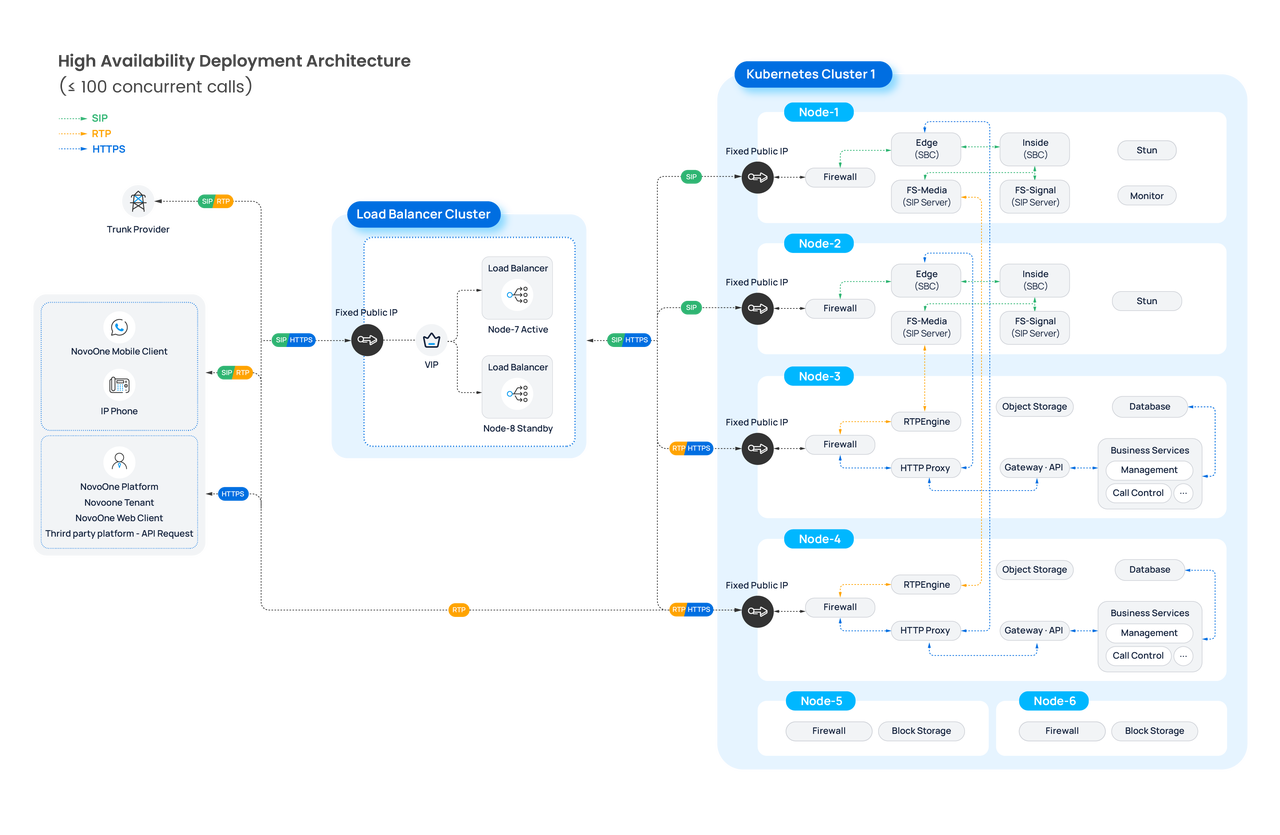
- Entry layer: A dedicated load balancer cluster, two nodes sharing one virtual IP, is the single entry point for all traffic. If one balancer node fails, the other takes over instantly and customer calls keep flowing. Even the front door has no single point of failure.
- Access layer: Call signaling and media are handled by SBC Edge at the network edge, while web and HTTP traffic flows through the Kubernetes-native Gateway API. Voice and business traffic each have their own door, so a busy web portal or a surge in API calls never degrades a live conversation.
- Service layer: A Kubernetes cluster spreads every microservice (FS-Signal, FS-Media, RTP Engine, tenant management, authentication, and provisioning) across multiple nodes, with each service running as multiple replicas. If a node or an instance fails, a replica on another node takes over automatically, and your tenants never know anything happened.
Two technology choices do the heavy lifting. Kubernetes orchestrates the cluster: health checks, self-healing, rolling upgrades, and fine-grained resource scheduling come as platform capabilities, not custom engineering you have to build or maintain. SIP Stack provides the carrier-proven communications core, deployed not as one monolith but as independent signaling and media services. Put simply: telecom-grade call handling, operated with cloud-platform efficiency.
The 6 sections below open up NovoOne’s architecture one capability at a time: the technical design behind it, the effect in plain terms, and exactly how it keeps your service highly available while your operating costs stay low.
1. Signaling and Media Split Protects Calls
Benefits:
- Uninterrupted Audio: Ongoing calls remain alive even if signaling experiences temporary disruption, preserving both your SLA and brand reputation.
- Precision Scaling: Expand only the bottlenecked resources, media nodes for concurrent calls or signaling nodes for high registration volumes, rather than purchasing full, over-provisioned servers.
- Faster Troubleshooting: Isolated fault boundaries instantly halve the search area for your engineering team, sharply reducing Mean Time to Resolution (MTTR).
2. Load Balancing That Carries More Business
How it works: Load balancing in NovoOne works at three levels. First, one entry point: a self-developed load balancing component fronts everything; your domains point to the LB, which routes call signaling directly to SBC Edge and web/HTTP requests through the Kubernetes-native Gateway API. Second, demand-responsive distribution: call load spreads evenly across multiple pods, and a new pod launches only when all existing replicas are fully loaded, so no idle resources spin up early. A 2025 Frontiers in Computer Science study on cloud data centers found that this kind of demand-responsive load balancing cuts failed or delayed requests by over 40% compared with simple round-robin scheduling. Finally, the balancer itself never becomes the weak link: the Edge access layer runs two replicas on separate VMs. This means no single server ever becomes the bottleneck, and no server sits overloaded while others idle.
- No Customer-Facing Incidents: If one pod misbehaves, traffic shifts to the healthy ones automatically, so a localized fault never becomes a service event.
- More Business per Server: Even load spreading means the same hardware carries more tenants and more calls, so profit grows with your user base, not your server count.
- One-Stop Management: With all domains unified behind the LB, certificate and domain management happens in exactly one place instead of once per server.
- Zero-Touch Scaling: When replicas are added or removed, they join traffic distribution automatically, with no manual routing or configuration changes.
3. Self-Healing Before Customers Notice
How it works: In NovoOne, Kubernetes health-checks every workload continuously. When a pod overloads or fails, a replacement is launched automatically, typically in 30 seconds to minutes depending on the service type, and rejoins traffic distribution on its own. If an entire node fails, workloads drift to healthy nodes, and a redundant VM carries the business until repairs are complete. This means a failed pod or even a whole server no longer pages anyone: the platform rebuilds capacity by itself, service recovers automatically, and new calls connect immediately.
Benefits:
- No Midnight Paging: The middle-of-the-night emergency restart is gone; your team starts the morning reading «system auto-recovered» instead of an incident report.
- Lower On-Call Load: Recovery is automatic, and there are no home-grown watchdog scripts to build or maintain, so on-call pressure drops.
- Minutes, Not Hours: Compressing recovery from hours to minutes keeps a routine failure from becoming a million-dollar outage. The stakes justify the design: the Uptime Institute’s Annual Outage Analysis 2026 found that, for the second year running, one in five organizations saw their most recent significant outage cost over $1 million.
4. Rolling Upgrades Without Maintenance Windows
How it works: NovoOne runs multiple active-active replicas that serve traffic at the same time. During an upgrade, pods are replaced one by one while healthy replicas keep serving, so core components upgrade with no impact on calls or business. You initiate upgrades yourself, on your schedule, during business hours, and if a single pod upgrade misbehaves, the rest of the service is unaffected and can be safely retried or rolled back. This means upgrades happen while your customers keep talking, with capacity at full strength throughout and no maintenance window at all.
Benefits:
- No Maintenance Windows: The 2 a.m. maintenance window where every tenant goes offline is gone, and so is the all-night rollback when something goes wrong.
- Daytime Operations: Your team works business hours instead of overnight shifts, shipping fixes and features on your own schedule. In a published Kubernetes case study, Woorank, a 12-engineer team running 50 microservices, saw infrastructure updates shrink from two full working days to «a few hours of passively following the process».
- No Downtime Credits: Tenants stay on full capacity throughout, so upgrades never translate into SLA compensation.
5. Built-In Observability Spots Problems First
How it works: A Grafana monitoring platform is built into NovoOne and runs inside your own VM resources, watching the entire call path: metrics stream in from every layer, signaling and media planes included, SLA health sits on live dashboards, and alerts fire the moment an anomaly appears. This means faults are found by the platform, not reported by customers.
Benefits:
- Early Warning: Issues surface on your dashboard before they surface in your support inbox, the difference between fixing a problem quietly and negotiating an SLA credit.
- Zero Extra Tooling: Full-chain metrics, alerts, and end-to-end troubleshooting come out of the box, with no third-party monitoring stack to purchase, deploy, and maintain.
- Faster Resolution: When an alert fires, troubleshooting starts from a dashboard of live evidence instead of digging through logs by hand while the clock runs.
6. Data Redundancy That Survives Failures
How it works: In NovoOne, storage and databases always keep at least two replicas, placed on different VM nodes, covering tenant configurations, call records, and business data. When a disk or the host server fails, the service fails over to a surviving replica automatically. This means a hardware failure is an incident you watch on the monitoring dashboard, not a data-loss event you spend days recovering from.
Benefits:
- No Permanent Data Loss: The data itself survives the failure intact, so your worst day is an outage you recover from, never records you cannot bring back.
- Recovery in Minutes: The automatic replica switchover replaces the restore-from-backup marathon, turning hours of recovery work into minutes.
- Free Reporting Access: Read-only database access lets you build custom reports and integrations without touching production.
Carrier-Grade Availability, Lower Operating Cost
For a multi-tenant provider, downtime, maintenance windows, and resource waste all scale with your tenant count, which is exactly why they hurt. NovoOne’s Kubernetes-based multi-tenant architecture attacks all three by design, and it does so on two fronts.
Lower Operating Cost
The savings land on specific line items, month after month. Spending stays predictable: the same servers carry more tenants, so your hardware bill grows well behind your revenue. Maintenance gets simpler: upgrades run in business hours, with no overnight windows to schedule, no upgrade downtime to apologize for, and no SLA credits to refund. On-call labor shrinks: midnight emergency restarts disappear from the rotation, and a failed disk is a minutes-long fix, not days of recovery work. None of these are one-off wins; they recur at every tenant count, and they compound as the platform grows.
Carrier-Grade Availability
For your tenants and your SLA, this translates into three things: service uptime that survives component failures, node outages, and even platform upgrades; call quality that stays clear and uninterrupted, even when traffic spikes or a component fails; and tenant trust, because routine incidents resolve before tenants notice, and your SLA holds through the failures that used to break it.
That’s what Kubernetes plus SIP Stack looks like when it’s engineered for service providers: uptime your customers can feel, and an operations budget you can see.
Ready to see NovoOne in action? Start a free trial to experience the call quality firsthand, or talk to our team about the deployment solution for unlimited tenants.